


Healthy bones help us keep doing the things we enjoy, from walking with friends to staying active through the years. Looking after them involves nourishing food, movement and meeting our nutritional needs, alongside caring for our wider wellbeing.
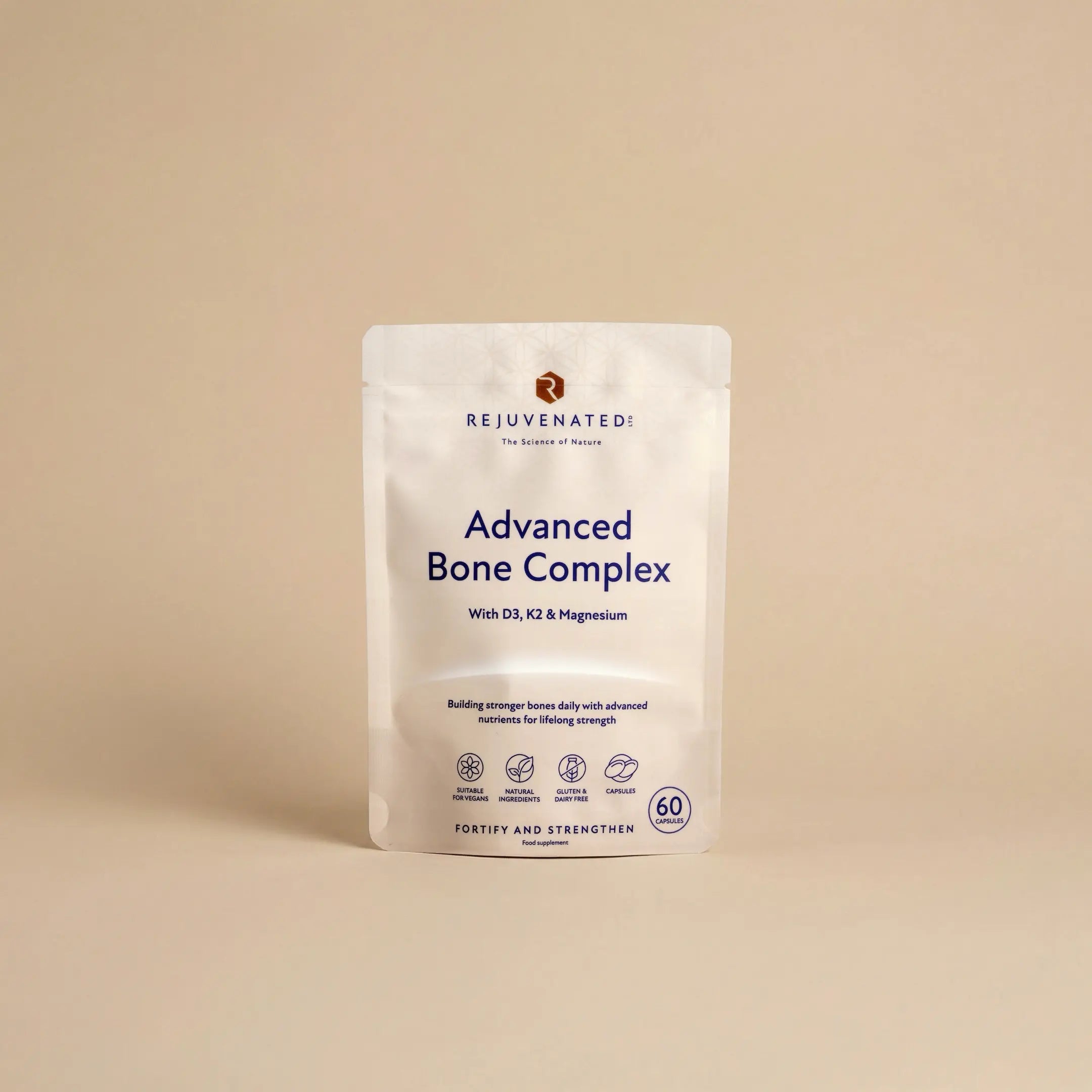
Rejuvenated Advanced Bone Complex brings together magnesium glycinate, vitamin D3, K2VITAL vitamin K2, vitamin C, silicon and boron. Magnesium and vitamins D and K contribute to the maintenance of normal bones, while vitamin C contributes to normal collagen formation for the normal function of bones.
Understanding the ingredients in Advanced Bone Complex
Each ingredient has its own research story. Established nutrient functions, changes in blood markers and improvements in bone density are different outcomes. The studies below help explain the science behind the ingredients; they are not clinical trials of Advanced Bone Complex itself.
At Rejuvenated, we draw on the latest clinical research into individual ingredients to create thoughtfully formulated combinations. Our aim is to bring complementary nutrients together in one convenient formula, making your daily routine simpler and reducing the need for multiple separate supplements.
Magnesium glycinate for bones and normal muscle function
Magnesium contributes to the maintenance of normal bones, normal muscle function and the normal functioning of the nervous system. Around half to three-fifths of the body’s magnesium is stored in bone. Magnesium glycinate is a form in which magnesium is bound to the amino acid glycine. [1]
Sleep is an area of growing research. A 2025 randomised, placebo-controlled trial in 155 adults reporting poor sleep tested magnesium bisglycinate providing 250 mg of elemental magnesium daily for four weeks. Participants reported a modest improvement in insomnia-severity scores compared with placebo. The study did not establish deeper sleep through objective sleep-stage measurements, and it did not test this formula. [2]
Vitamin D3 and calcium absorption
Vitamin D contributes to normal calcium and phosphorus absorption and utilisation, the maintenance of normal bones and normal muscle function. This helps explain why vitamin D matters in a bone-health routine, even when calcium comes mainly from food. [3]
Meeting nutritional needs is different from assuming that higher doses provide greater protection. In the large VITAL trial, 2,000 IU of vitamin D3 daily did not reduce fractures in generally healthy midlife and older adults who were not selected for deficiency or osteoporosis. Individual needs and baseline status matter. [4]
Vitamin C and the collagen framework of bone
Bone contains a collagen-rich framework as well as minerals. Vitamin C is needed to make collagen and contributes to normal collagen formation for the normal function of bones. Meeting vitamin C needs is therefore one part of everyday bone care. [5]
Vitamin K2 and the maintenance of normal bones
Vitamin K contributes to the maintenance of normal bones and is involved in activating proteins such as osteocalcin. Advanced Bone Complex includes K2VITAL vitamin K2. Clinical research on vitamin K2 has studied different preparations, doses and groups of people, so findings need to be read in that context.
In a three-year trial involving 244 healthy postmenopausal women, 180 micrograms of menaquinone-7, or MK-7, daily reduced the decline in bone mineral density at the lumbar spine and femoral neck, but not at the total hip, compared with placebo. [6]
Results have not been uniform. Another three-year trial in 142 postmenopausal women with osteopenia found no significant advantage in bone mineral density from 375 micrograms of MK-7 daily when both groups also received calcium and vitamin D. These studies support an informed discussion of vitamin K. They do not establish that every K2 formulation has the same effect or that this product treats osteopenia which is why we chose K2VITAL for our formula. [7]
Silicon and research into bone formation
Silicon is present in foods and has been investigated for its possible role in bone and connective tissue. The most useful clinical evidence relates to particular silicon preparations, rather than silicon supplements as a whole. A 12-month trial randomised 184 women with low bone density to choline-stabilised orthosilicic acid or placebo, alongside calcium and vitamin D; 136 completed it. Some doses improved a marker of type I collagen formation, but there was no significant overall change in lumbar-spine bone density. A favourable femoral-neck result came from a post-hoc subgroup analysis. [8] This is early, formulation-specific evidence. It cannot automatically be applied to all supplements.
Boron and mineral metabolism
Boron is a trace element found naturally in plant foods. Its possible relationship with mineral metabolism has attracted research interest, although its human biological role and clinical benefits are less established than those of magnesium or vitamins D and K.
A small metabolic study in 12 postmenopausal women examined 3 mg of boron daily after a low-boron diet and reported changes in calcium and magnesium excretion. It measured mineral handling, not fracture prevention or a proven increase in bone density. Larger clinical trials are needed before firm bone-health benefits can be claimed. [9]
Why bone health is about more than one supplement
Advanced Bone Complex can be considered within a wider nutritional routine. Calcium-rich foods, enough protein and appropriate weight-bearing and resistance activity remain important. If you have been diagnosed with low bone density, follow your clinician’s advice about exercise, nutrition and any treatment you need.
Read about bone health in your forties and fifties
Sleep and your body clock belong in the conversation
Bone is living tissue that is continually renewed throughout the day and night. Bone turnover has daily rhythms, and researchers are investigating how sleep and circadian timing influence this process.
In a small experimental study, ten men underwent approximately three weeks of restricted sleep alongside a deliberately disrupted body-clock schedule. A blood marker of bone formation fell, while a marker of bone breakdown did not change significantly. This suggests that sleep and circadian disruption can affect bone metabolism, but the study did not measure a supplement’s effects or prove that taking nutrients at bedtime improves bone density. [10]
For everyday wellbeing, an evening routine can be a helpful way to make time to unwind and remember your supplement. It is a practical habit, rather than a proven requirement for the nutrients to work.
Create a consistent sleep routine with our sleep plan
Explore meal timing and your circadian rhythms
Building a routine that suits you
Choose regular sleep and waking times where possible, allow a little time to wind down and make your bedroom comfortable for rest. Keep nourishing meals and enjoyable movement part of your day. Take Advanced Bone Complex according to the current label directions, and check the combined amounts if you use other supplements containing the same nutrients.


